
This is a time of year when many medical boards are coming up in the next one to three months. So, for many exam candidates, their remaining study time is growing short. Indeed, some exam candidates have a mere one to three weeks left to go.
This blog post is for anyone who feels they’re behind in their board prep and is beginning to panic. Let this post serve as an antidote to that counterproductive, panicky feeling. Let it provide the reader with an effective path forward.
Soldier’s Mindset
When your time to exam is short and preparation far from adequate, there is no room for indulging in self-recrimination, worry thoughts, or falling into panic.
Imagine you’re a soldier in a war zone. If you do not maintain a single-minded focus on staying alive and meeting your objectives, you are unlikely to live another day. Letting oneself fall into any kind of thoughts or emotions antithetical to staying alive must be ruthlessly guarded against.
Of course, you may well ask, “But how can I keep myself from thinking about how poorly prepared I am and imagining how likely I am to fail?”
I’ll tell you. There is a single antidote to counterproductive thoughts, feelings, and behavior: do that which is productive to passing. And that is – wait for it – preparing for the exam.
I’m not asking you to stop beating yourself up or imagining getting an exam failure notice or how you’ll feel letting your job administrators know you’re still not board-certified and to instead just let your mind go blank!
That won’t work, even for most master meditators. No! I am saying you occupy yourself productively in a disciplined manner and it is this productive activity that keeps those counterproductive thoughts, feelings, and behaviors away.
You simply have no time to indulge in fretting. And, yes, I realize how strangely captivating worry ruminations can be. (I won’t go into why that is here. We don’t have time for that now.)
My motto is: study is the enemy of worry just as worry is the enemy of study.
When you worry, you feel enervated, demoralized and devoid of energy and motivation.
So, when you catch yourself worrying or self-flagellating, stop! And let these thoughts become a trigger to go back to productive exam prep. Let me remind you: keep the Soldier’s Mindset. A moment’s distraction on the battle field can lead to death. A moment’s distraction with negative thoughts often leads to a long train of more and more disheartening and self-abuse thoughts.
The Doc Sutton Rule
When time is short – too short to go through all the exam prep material systematically – what should you do?
Answer: follow the Doc Sutton Rule: Go where the bulk of the exam questions are. On all medical board exams, there are topics with many more questions associated with them than with other, often equally complex, topics.
On medical board exams, about two thirds of the exam questions are on about one third of the topics. See the Internal Medicine Certification Exam Blueprint below. The top 6 out of 18 topics account for 59% of the exam questions.
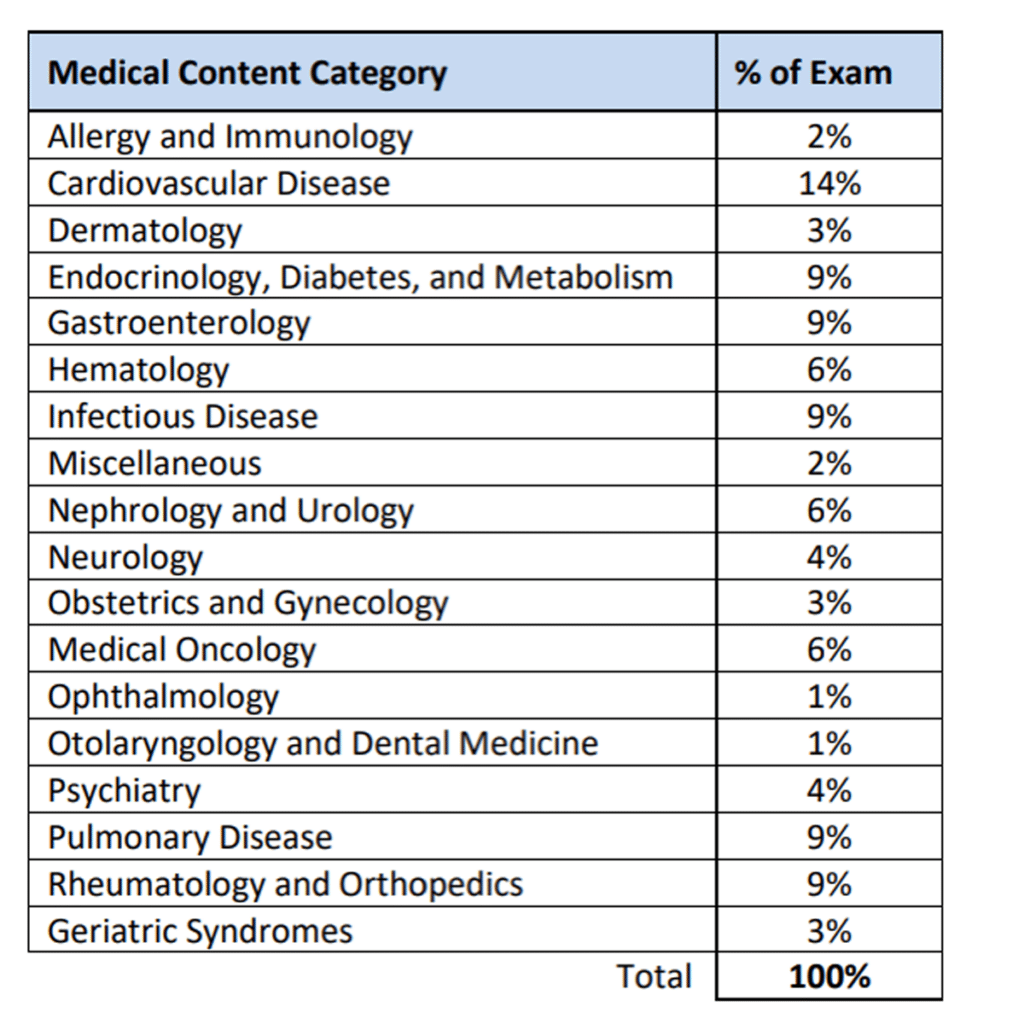
Certain topics, usually the bread and butter of clinical cases in your specialty or subspecialty, are much more heavily weighed than others. And within a disease category, most questions relate to treatment and second most to diagnosis and diagnostic assessment. All this makes sense: board exam designers want to ensure that board certified physicians will not make rookie, potentially lethal mistakes. So, that which can lead to a patient’s death or injury, whether through inadequate diagnostic assessment or ill-considered care, is prioritized.
Here are some exam examples of a single disease category that have the most exam MCQs associated with it and, in parentheses, the percentage of exam MCQs associated with the top exam topics:
- Internal Medicine Cert: Cardiovascular Disease 14% (top 6 of 18 topics = 59% of exam MCQs)
- General Surgery Qualifying: Alimentary Tract 15% (top 3 pf 13 topics = 37% of exam “patient care” MCQs)
- Neurology Cert: Neuromuscular Diseases: 11% (top 6 of 18 topics = 58% of exam MCQs)
- Psychiatry Cert: Tie between Psychotic Disorders and Depression: 10% each (top 5 of 24 topics = 44% of exam MCQs)
Some exams have more complex content blueprints. For example, take the Anesthesiology ADVANCED exam blueprint. There is a two level breakdown.
Here is the first level breakdown:
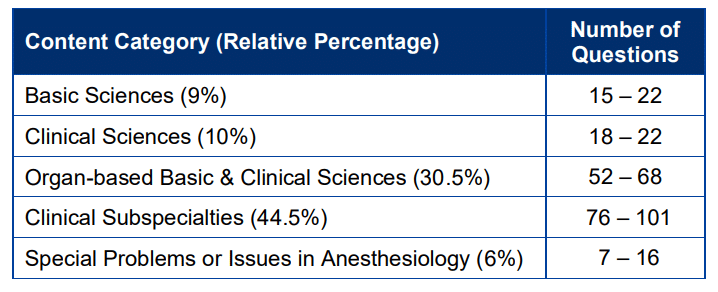
From this we learn that Organ-based Basic & Clinical Sciences and Clinical Subspecialties together account for 75% of all ADVANCED exam MCQs. Next we can then focus on the second level breakdown:
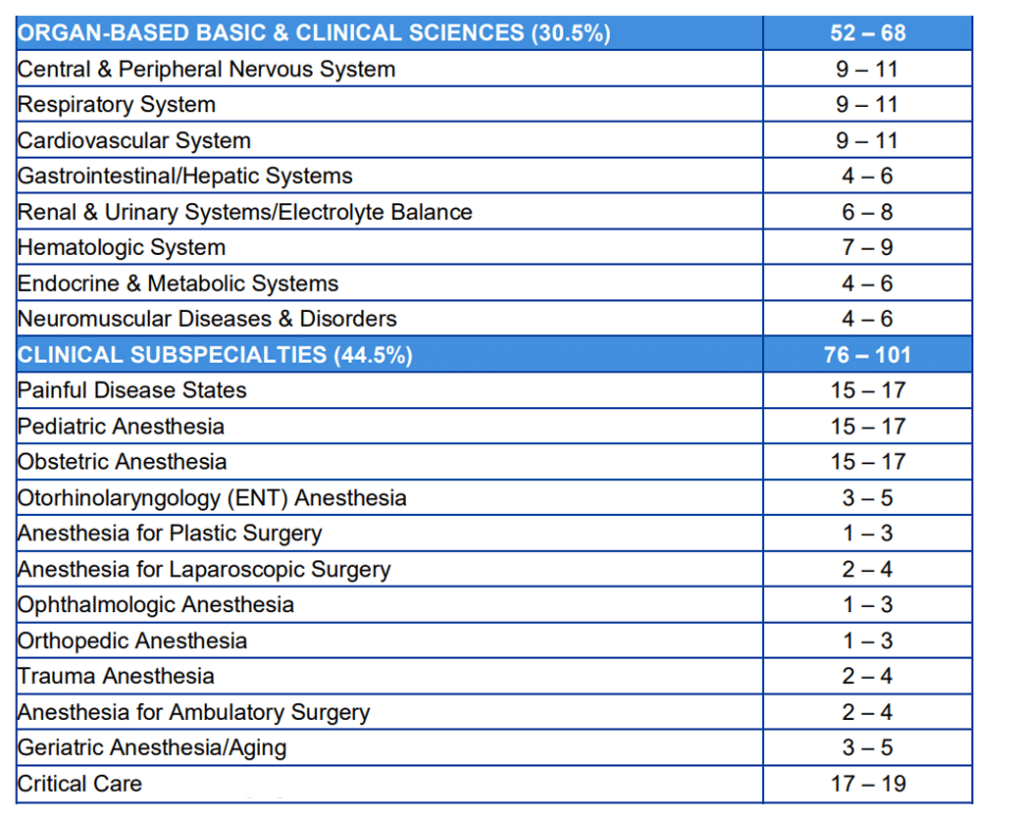
And it is from the above that we can get to the actual most covered topics.
So, please review your exam blueprint and identify the top topics. These are the ones you’ll need to focus on when time is short. Of course, if you have remaining time, you should go down the list to the smaller topics. But realize and accept, you’re unlikely to get through all the topics. Such is life.
There is one additional aspect to cover. As a practicing physician in your specialty, there will be topics that you are much more knowledgeable about. Do you still focus on these first?
Here is my advice: do a practice test of exam-style questions on a top topic that you’re expert on. This way, without devoting much time, you’ll be able to gauge how prepared you are in answering that topic’s questions. You will either do very well and develop a sense of confidence that will give you momentum to tackle topics you’re less familiar with and / or you will identify certain shortcomings in your knowledge despite practicing in that area. It is not uncommon that physicians specializing in a certain disease or treatment category are still (unpleasantly) surprised by the type of questions in that category that are presented on the exam. You might be an experienced clinician but you might not be knowledge about how that content knowledge is tested on board exams. That’s why it’s worthwhile to assess your comfort level with exam MCQs even in your areas of expertise.
Every Little Bit Counts Mindset
When you’re preparing with little time left, you will have moments of feeling overwhelmed and will, once again, begin to beat up on yourself and second guess your ability to pass. When this occurs, return to the Soldier’s Mindset. You simply can’t afford to succumb to counterproductive reactions.
It will likely be hard to maintain this Soldier’s Mindset and the motivation to keep going when you – realistically – judge your inability to get through all the exam material in time. What then?
Then, this is the next mindset to keep in mind: every few minutes of exam preparation increases your chances of passing. If you have just spent 5 (or 65) minutes fretting, you have deprived yourself of those minutes of what could have been exam prep time. Of course, a small amount of prep time will likely result in a small increase in your probability of passing. But so what? You don’t know ahead of time how you’ll do on the exam, how close or far from passing you’ll be or of failing you’ll be.
The hardest pill for exam-takers who fail to swallow is when they fail by a small percentage, one that translates into a mere handful of missed exam MCQs. “If only, if only …”, they keep thinking.
You are preparing under conditions of uncertainty: you don’t know the exact questions you’ll encounter on the exam nor what your score will end up being. It’s a percentages game: you can miss a lot of questions and still pass. And it’s a probability game: you don’t know when you’re finally ‘ready’ to take the exam. All you can count on is that on average more study beats less study. Every few minutes of study is meaningful and should be taken advantage of.
No Med Experimentation Rule
Never take a performance-enhancing medication for the first time immediately before your exam. I’m not against, for example, taking something to calm your nerves, like a low dose benzo, nor something to sustain your focus and energy, like a stimulant. What I am against is doing so right before your exam without ever having tried this med before.
The 1-2 mg of Ativan you thought would calm you down, may make you extremely drowsy instead. That methylphenidate may increase your anxiety and give you a racing heart.
I’ve seen how even low doses of psychotropic meds do a number on exam-takers without experience taking that particular med. Sometimes these meds’ effects are a lot more robust then expected, given their ‘low’ dose.
So, not only assess these meds beforehand, but assess their effects across the entire duration of your exam. Some certification exams last 10 hours when you include the lunch hour. You benzo you take may be great for the first hour or two, but how will you feel under its influence at hour 5, 7, or 9 of the exam? Don’t trust – verify ahead of time.
Taking the Exam – Back to Soldier’s Mindset
The Soldier’s Mindset applies even more strongly to taking the exam. For the entire time you’re taking the exam, you must hold yourself in attention to the current moment. This means: pay attention to the current question you are answering. It is extremely easy to start focusing on previous questions, especially the ones you’re not sure about. And guess what? You will not be sure about the majority of the questions you answer on the exam. Of course, most of these questions you will get right, but you can’t be sure you’re right about them at the time. Even seemingly easy questions are ripe for second-guessing.
Second-guessing the answer to a question is bad enough when you’re in the middle of answering that question, but it’s entirely and devastatingly bad when you’re second-guessing a question you answered earlier. Why? Because that means you’re not paying attention to the current question.
Thus: one flagrant self-sabotaging exam performance behavior is thinking about (second-guessing) previous questions. You then can go through an entire exam without fulling paying attention to any of the questions because you’re mind is often on what happened earlier or what might occur in the future, such as fretting about running out of time, failing the exam, waiting for exam results, what you’ll tell your family when you get your notice of failure, etc, etc, etc. One can end up thinking everything but the questions that are at hand.
Back to Soldier’s Mindset: if you ain’t paying attention to the present – not maintaining situational awareness – you’re a dead man walking.
After you finish the exam, then you can: get drunk, cry in your car, rend your clothes, walk off a pier, etc. Do what you want, but not until later. Now, pay attention to NOW.
Is it hard to pay attention to the present question? Sometimes it is, but when those distracting thoughts and images come, you must place them aside or let them pass over you without engaging them.
What works for me: I move through exam questions as fast as I can. I don’t rush through them though. I read each vignette and question carefully; I reread them if my attention strayed; I read all the response options; and I choose an option as soon as I have found the most likely one. I don’t think “Oh, This is right.” Instead, I think “This one most likely is the right one.” If I’m stymied, I give myself about 15 seconds to choose and then I decide. I choose based what I think makes the most sense clinically, in the real world. I don’t try to second-guess what the question writers might have had in mind; that’s more likely a losing strategy. I choose an response option and leave the question in the past. I never think about it again. I usually finish the exam with one half or one third of the time left.
I’m not saying my way is the right way. It is the right way for me. I have so much nervous energy, I just need to keep moving. And I want to go as fast as I can – without rushing – to get this ‘f***ing exam over with. Then I leave the building, turn around, give it a middle finger, and then get sushi and beer for my post exam dinner. Yes, I do have a traditional after-exam dinner. I don’t talk to anyone, take a long walk, and just decompress that evening.
I know plenty of docs who take every minute of the allotted exam time. I know others who power through even faster than I do. There is no universal right way, only individual right ones.
Preparing for the exam requires learning the exam content, learning how the exam content is tested, and learning one’s optimal exam-taking approach.
Last point about exam-taking strategies and the Soldier’s Mindset: get a good night sleep the night before the exam. The exams are long and draining. It is counterproductive to stay up studying the last night. Mostly, it’s wasted effort reading and rereading exam material when you’re probably not even paying attention to what you’re reading. You’re wasting time not advancing your knowledge while leaving yourself physically and mentally drained for the long, hard day ahead. Don’t go into battle already feeling tired and defeated.
Conclusion
If you have 10-20 total hours of time you can devote to study, please devote it to study. Do not tell yourself it’s not worth it. It is. You can learn a lot of exam content, get used to taking practice exams, learn your question-answering pace, in that space of time.
And, if you end up failing, it’s better to fail after giving it your best shot. If you give up too early and fail, you’ll feel like a dufus. No reason to do that. Respect yourself. Respect your efforts. Do your best. Don’t predict failure and give up before the clock runs down. Let the chips fall where they may. If you fail, you’ll eventually succeed. You will not be kept down.
Stay disciplined, rested, and hydrated. Get out there and kick some butt.
All the best,
Jack Krasuski, MD

 American Physician


Leave a Reply